.webp)

Sandeep Singh Sisodiya
Webflow
February 19, 2026


Insights, ideas, and expert perspectives shared by the author on design, development, and digital growth.
In the modern startup ecosystem, speed is not just an advantage but a survival requirement. New companies operate in highly competitive markets where timing, clarity of communication, and rapid execution determine whether an idea gains traction or fades into obscurity. A startup’s website sits at the center of this race. It serves as the primary platform for communicating value, attracting customers, capturing leads, educating users, building credibility, and supporting marketing campaigns. Unlike established enterprises that can afford lengthy development cycles, startups need a website that can be designed, built, launched, and refined quickly without sacrificing quality.
Traditional web development methods often create friction for early-stage companies. They involve multiple tools, separate teams, long approval chains, complex hosting setups, and continuous technical maintenance. These factors slow down progress and consume resources that startups simply cannot spare. Webflow addresses these challenges by providing an integrated visual development platform where design, development, hosting, and content management exist in one environment. This allows teams to launch faster, operate more efficiently, and adapt to changing market conditions without rebuilding from scratch. The following detailed guide explains how Webflow empowers startups to build smarter websites, accelerate growth, and maintain flexibility as they scale.
Before exploring technical advantages, it is important to understand why a website is such a critical asset for startups.
For most potential customers, partners, or job candidates, the website is the first interaction with the company. Within seconds, visitors form judgments about professionalism, reliability, and competence. A modern, well-structured site signals legitimacy, while a poorly designed one can create doubt even if the product itself is strong.
All digital marketing channels ultimately drive traffic back to the website. Paid advertisements, social media campaigns, email marketing, and search engine optimization efforts rely on landing pages to convert interest into action. Without a high-performing website, marketing investments produce limited results.
Investors frequently research startups online before meetings. A clear website that communicates vision, traction, and differentiation can strengthen confidence. It demonstrates that the founders understand positioning and are capable of execution.
Startups often introduce new concepts that require explanation. The website provides space to educate visitors about the problem, solution, technology, and benefits. It allows the company to shape its narrative rather than relying on external interpretations.
Because the website plays such a multifaceted role, launching it quickly and maintaining flexibility is essential.
Traditional web development follows a linear process that is often incompatible with startup speed.
Designers typically create visual mockups using graphic tools. Developers then translate those designs into code. Any discrepancy between the design and the implementation requires revisions, which creates additional cycles. This separation introduces delays and increases the risk of miscommunication.
Even minor updates such as changing text, adding a new section, or adjusting layout elements often require developer intervention. For startups whose developers are focused on building the core product, website updates become low priority and progress stalls.
Traditional sites require server configuration, security management, backups, and performance optimization. These tasks demand technical expertise and ongoing attention.
Hiring multiple specialists or agencies increases costs. For early-stage companies with limited funding, these expenses can consume valuable runway.
Webflow addresses these limitations by combining multiple functions into a single platform.
One of Webflow’s defining strengths is its visual development approach.
In Webflow, designers work directly on the live structure of the site. Elements placed on the canvas become part of the actual webpage, not just a visual representation. This removes the need for a separate coding phase to recreate designs.
Behind the scenes, Webflow produces clean, standards-compliant HTML, CSS, and JavaScript. Startups benefit from professional code quality without writing it manually.
Teams can see how updates affect layout and responsiveness instantly. This real-time feedback accelerates decision-making and reduces uncertainty.
Because design and development occur simultaneously, there is less chance of discrepancies between intention and outcome. What is designed is exactly what gets deployed.
This visual workflow dramatically shortens development timelines.
Startups must validate ideas quickly to avoid investing in the wrong direction.
Webflow allows teams to build a polished website within days. This enables founders to present their concept publicly, collect feedback, and measure interest before committing significant resources.
Once traffic begins arriving, startups can analyze user behavior and refine messaging accordingly. Changes can be implemented immediately, allowing the site to evolve alongside the business.
Marketing initiatives often require dedicated pages tailored to specific audiences. Webflow makes it easy to duplicate existing pages, adjust content, and launch new variations rapidly.
This ability to test and adapt supports smarter strategic decisions.
Managing hosting environments can distract startups from their core mission.
Webflow hosting includes global content delivery networks that distribute content efficiently across regions. This ensures fast load times for users worldwide.
SSL certificates, backups, and updates are handled automatically. Startups do not need to worry about configuring encryption or monitoring vulnerabilities.
If a marketing campaign goes viral or media coverage drives sudden traffic, the hosting environment can handle increased demand without manual intervention.
By removing infrastructure concerns, Webflow allows teams to focus on growth.
Content is essential for attracting organic traffic and nurturing leads.
Webflow’s CMS enables startups to define content types such as blog articles, case studies, team profiles, and testimonials. Each entry automatically generates a consistent page layout.
Marketing teams can publish new content or update existing pages without technical assistance. This accelerates publishing cycles and encourages experimentation.
Templates ensure that every piece of content adheres to the same visual standards, maintaining a professional appearance as the site grows.
This autonomy empowers non-technical team members to contribute directly to growth.
Standing out visually is crucial in competitive markets.
Webflow offers precise control over spacing, typography, colors, and structure. Startups can create distinctive designs rather than relying on generic templates.
Animations, transitions, and micro-interactions can be implemented visually. These features enhance engagement and create memorable experiences.
A well-designed site communicates professionalism and builds trust with visitors, partners, and investors.
Unlike restrictive builders, Webflow supports truly custom digital identities.
Mobile devices account for a significant share of web traffic.
Designers can adjust layouts separately for desktop, tablet, and mobile views, ensuring usability across screen sizes.
Images are automatically optimized for different devices, improving performance and reducing loading times.
Readable text, intuitive navigation, and responsive layouts keep visitors engaged regardless of device.
A mobile-friendly site ensures broader reach and higher satisfaction.
Search engines remain a primary source of traffic for many startups.
Webflow supports SEO through customizable metadata, clean semantic markup, automatic sitemap generation, and fast performance. These features help search engines understand and rank the site effectively without requiring extensive technical configuration.
Managing expenses is critical for startups operating on limited funding.
Because Webflow integrates multiple functions, there is less reliance on plugins or third-party services that may incur additional costs.
Automatic updates and security features reduce the need for dedicated technical maintenance.
Hosting and platform services are bundled, making budgeting easier and more transparent.
Lower operational overhead allows startups to allocate resources to core activities.
Websites must connect with broader operational tools.
Webflow supports embedding analytics scripts, connecting forms to CRM systems, integrating email marketing platforms, and linking automation workflows. This transforms the website into an active component of the company’s growth infrastructure rather than a standalone asset.
Although Webflow is user-friendly, complex projects may benefit from specialized knowledge. Working with a webflow development agency can help startups implement advanced features, optimize performance, and design conversion-focused experiences. Comprehensive webflow website development services can also ensure scalability and alignment with long-term business goals.
A platform must support expansion without requiring migration.
Webflow accommodates larger content libraries, more complex navigation systems, and additional functionality as needs evolve. This continuity prevents disruption and preserves accumulated search authority.
Startups operate under intense pressure to move quickly while maintaining professionalism and credibility. Traditional website development methods often introduce delays, increase costs, and create dependencies that conflict with these priorities. Webflow transforms the process by combining design, development, hosting, and content management into a unified platform. This integration enables teams to launch high-quality websites rapidly, iterate based on real feedback, and maintain performance without complex technical management.
More importantly, Webflow empowers founders and marketing teams to take control of their digital presence. By reducing bottlenecks and supporting continuous experimentation, it aligns perfectly with the agile mindset that drives successful startups. From early validation to large-scale growth, the platform provides the flexibility, scalability, and efficiency required to compete in fast-moving markets. For startups seeking to launch faster and operate smarter, adopting an integrated visual development approach can become a decisive advantage that accelerates progress and supports long-term success.
Webflow has emerged as one of the most powerful website development platforms for modern businesses. It offers unmatched design flexibility, robust content management capabilities, responsive performance, and clean code output. From startups to enterprise level organizations, companies across industries are choosing Webflow to build scalable, high performance websites that combine visual excellence with technical strength. As the platform continues to grow in popularity, the demand for certified and experienced Webflow partners in India has significantly increased.
Choosing a Webflow Premium Partner India agency ensures that your website is built by professionals who understand advanced Webflow capabilities, structured CMS architecture, responsive frameworks, performance optimization, and marketing integration. These agencies are known for delivering high quality Webflow projects aligned with business goals, conversion strategies, and long term scalability. In this detailed guide, we explore leading Webflow Premium Partner agencies in India, highlighting their location, expertise, strengths, services, and industry focus in equal depth.
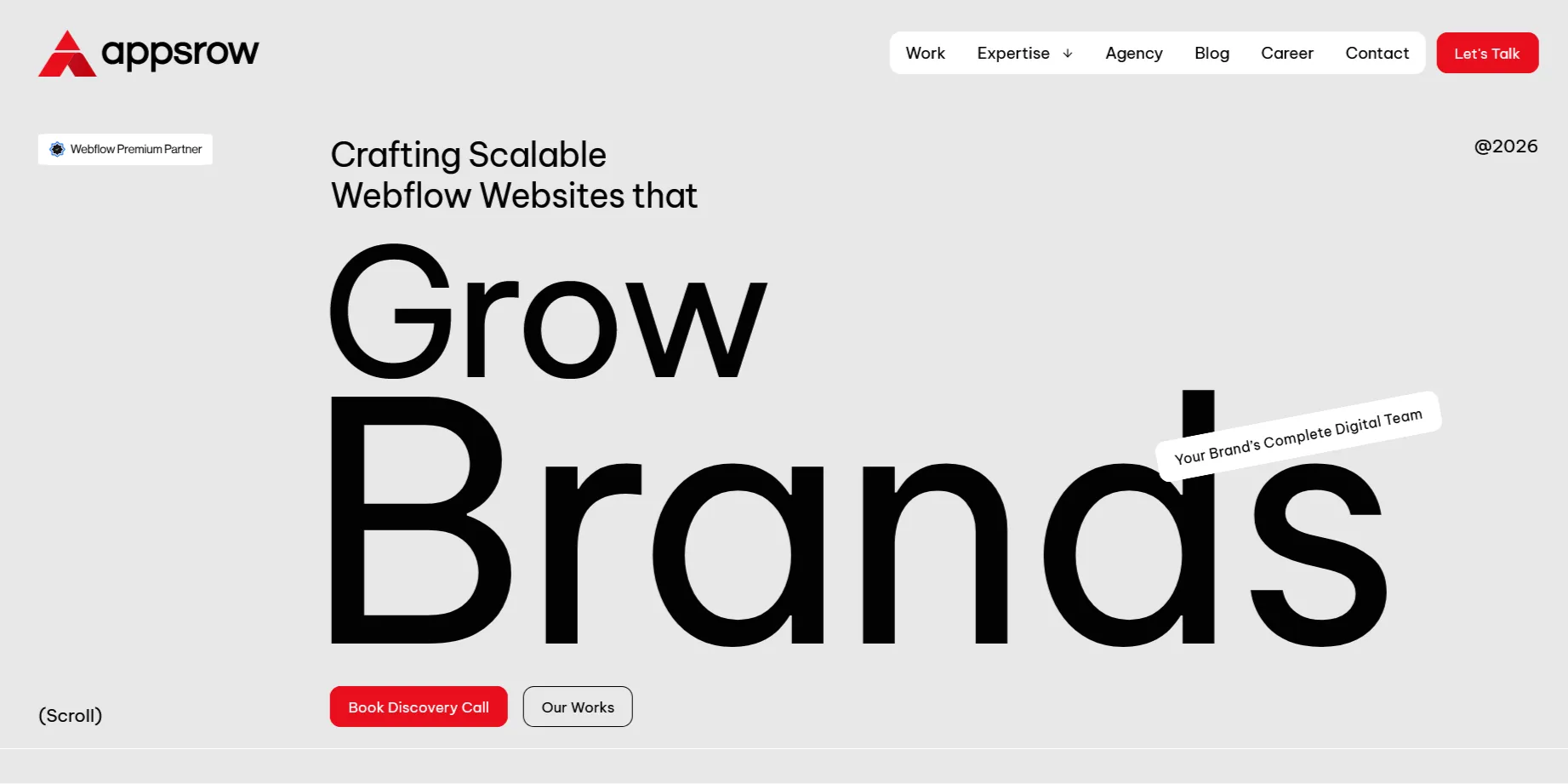
Appsrow is positioned as a strategic Webflow Premium Partner India agency known for delivering structured, scalable, and performance driven Webflow solutions. The agency focuses on building websites that are not only visually impressive but also technically optimized for growth, lead generation, and long term digital expansion.
Appsrow specializes in custom Webflow website design and development tailored to business objectives. Their expertise includes advanced CMS architecture, dynamic content systems, scalable component structures, interaction design, animation implementation, and technical SEO optimization. They build modular design systems within Webflow that allow businesses to maintain visual consistency while expanding their digital presence over time.
The team works extensively on complex Webflow builds including SaaS websites, B2B corporate platforms, landing page ecosystems, and content driven portals. They also implement CRM integrations, automation tools, analytics tracking systems, and marketing technology integrations directly within the Webflow framework.
Appsrow provides end to end Webflow services including discovery workshops, UX research, wireframing, UI design, Webflow development, CMS configuration, third party integration, website migration, performance optimization, and post launch support. They also offer ongoing Webflow maintenance and scalability planning.
One of the primary strengths of Appsrow is its structured development methodology. The agency follows a systematic approach from planning to deployment, ensuring that every project aligns with measurable business objectives. Their ability to combine user experience strategy with technical SEO and performance optimization makes them a strong choice for businesses seeking long term digital growth.
Appsrow serves SaaS companies, technology startups, fintech platforms, ecommerce brands, and professional service providers that require scalable Webflow solutions.
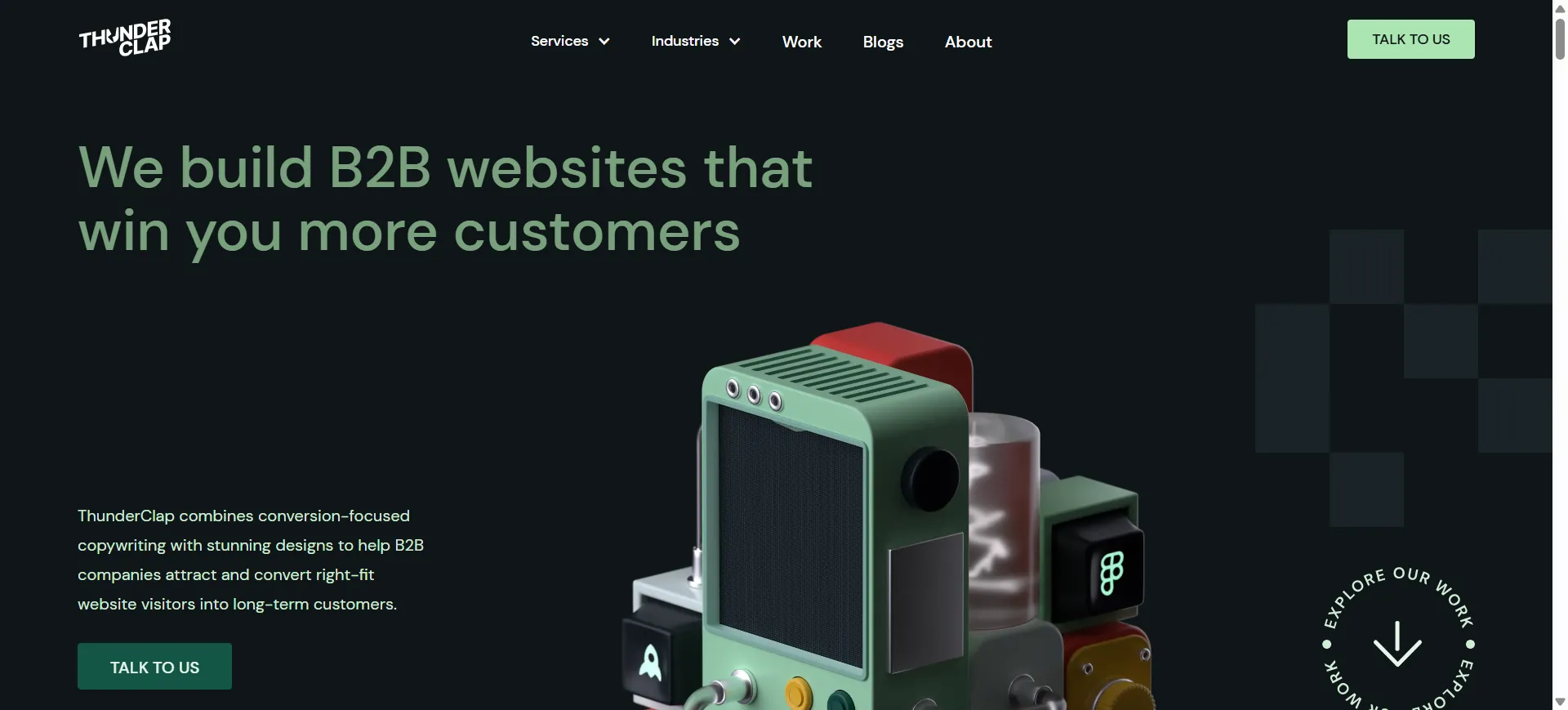
The ThunderClap is a design focused Webflow Premium Partner India agency recognized for creating visually immersive digital experiences. The agency emphasizes brand storytelling and visual engagement while maintaining technical precision within Webflow builds.
The ThunderClap excels in high end UI design, interaction design, and animation rich Webflow websites. Their expertise includes scroll based animations, layered transitions, interactive elements, and responsive design systems that maintain visual integrity across devices.
They approach Webflow projects with a strong emphasis on branding, ensuring that typography systems, color hierarchies, layout grids, and visual components reflect the brand personality. Their Webflow development integrates smooth navigation flows and clear conversion pathways.
Services include brand strategy workshops, UI and UX design, Webflow development, landing page creation, website redesign, CMS configuration, and website optimization. They also support campaign specific Webflow builds for product launches and marketing initiatives.
The key strength of The ThunderClap lies in its ability to merge brand strategy with Webflow development. Their websites often stand out visually while maintaining performance standards and structured backend organization.
They work with creative brands, SaaS startups, digital marketing companies, and enterprise level businesses looking for strong visual representation online.
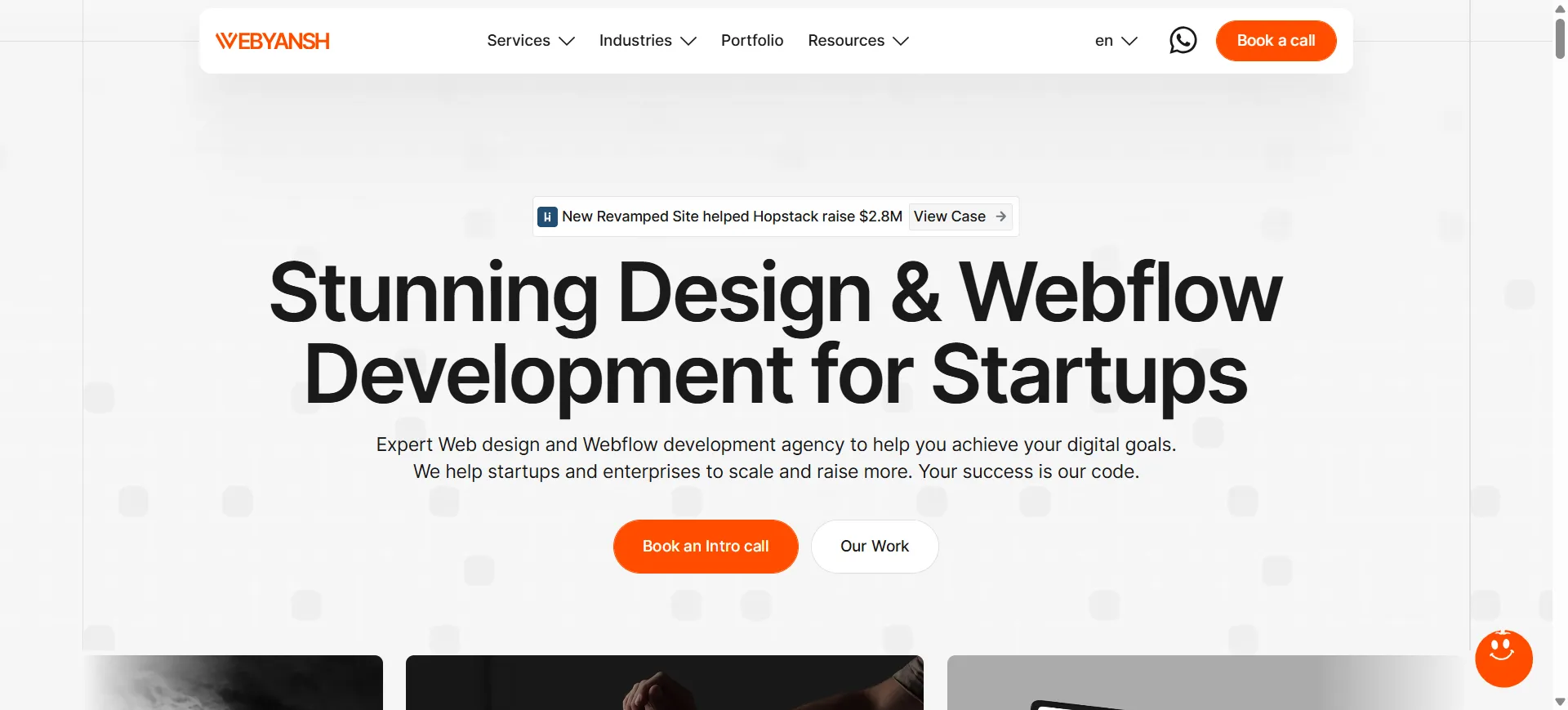
Webyansh is a growth oriented Webflow Premium Partner India agency known for integrating SEO strategy directly into Webflow development. The agency focuses on building search optimized and content ready websites that support organic traffic growth.
Webyansh specializes in SEO focused Webflow builds. Their expertise includes structured heading hierarchy, optimized metadata, internal linking architecture, schema readiness, image optimization, and performance enhancements within Webflow.
They design scalable CMS systems for blogs, knowledge bases, resource centers, and content marketing platforms. Their migration services help businesses move from other platforms to Webflow while preserving SEO value.
Webflow website development, SEO integration, website migration, CMS structuring, technical optimization, and analytics implementation are part of their service offerings.
Webyansh stands out for combining Webflow development with measurable search performance strategy. Their structured content architecture enables businesses to scale traffic over time.
They serve SaaS companies, ecommerce platforms, content heavy brands, and marketing driven organizations.
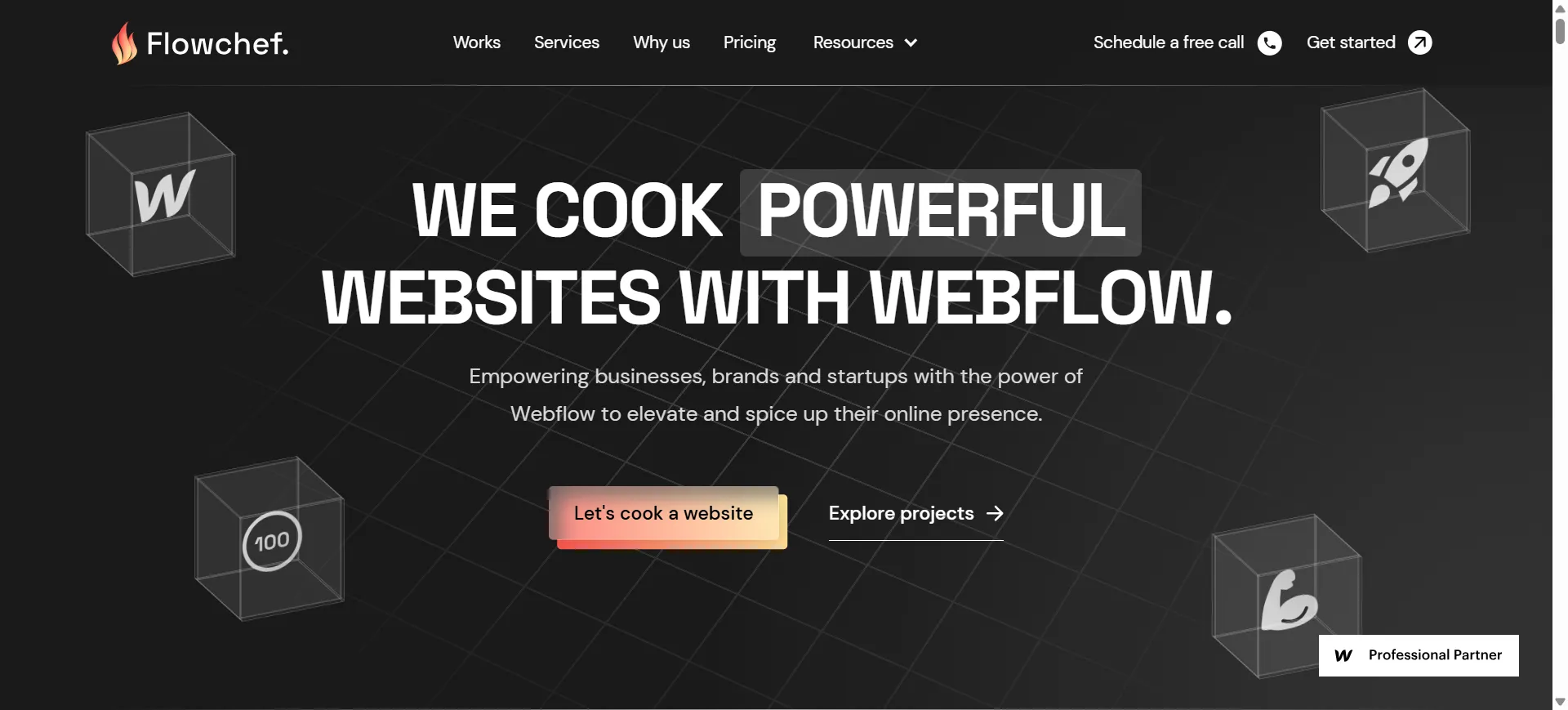
Flowchef is a Webflow Premium Partner India agency focused on delivering clean, performance oriented Webflow websites for startups and growing businesses.
Flowchef emphasizes efficient layout structures, clear navigation, and streamlined user journeys. Their Webflow builds are optimized for speed, usability, and clarity. They focus on simple yet effective design frameworks that prioritize user action.
The agency builds campaign landing pages, business websites, and CMS driven platforms with structured backend organization.
Their services include Webflow website design, landing page development, CMS setup, responsive optimization, and team training for content management.
Flowchef’s strength lies in delivering fast loading and conversion focused Webflow websites within structured timelines. Their clarity driven approach supports marketing performance.
They primarily work with startups, small businesses, and marketing focused teams seeking agile Webflow development.
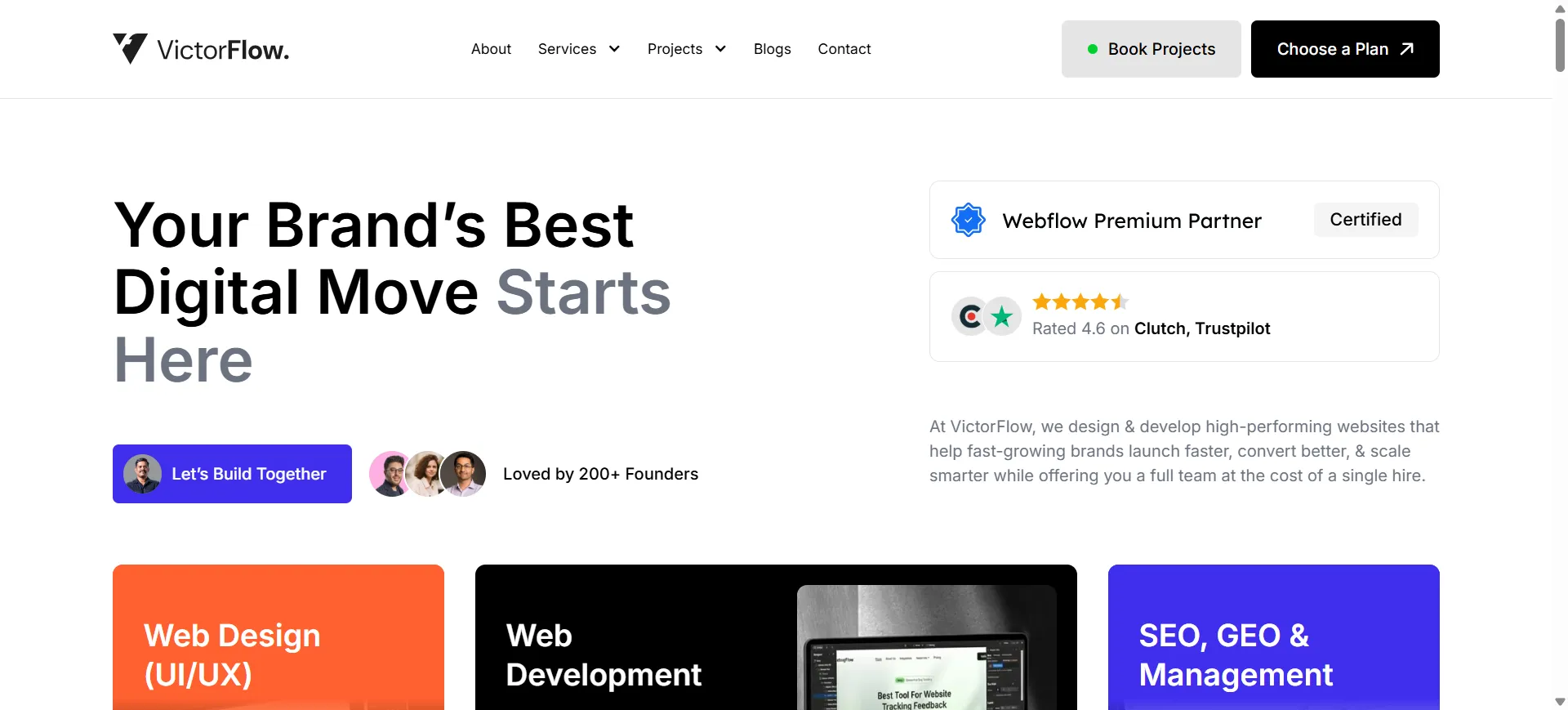
Victorflow is a Webflow Premium Partner India agency known for building structured and professional Webflow websites tailored for corporate and B2B brands.
Victorflow develops modular design systems within Webflow to ensure consistency and scalability. Their expertise includes CMS architecture, reusable components, structured design grids, and responsive frameworks.
They focus on corporate website design, SaaS platforms, and professional service websites that require credibility and polished presentation.
Services include Webflow website development, CMS configuration, UI design, corporate branding integration, and website optimization.
Victorflow’s strength lies in delivering structured and scalable Webflow builds that align with corporate standards and long term expansion strategies.
They serve B2B brands, SaaS companies, technology firms, and enterprise level organizations.
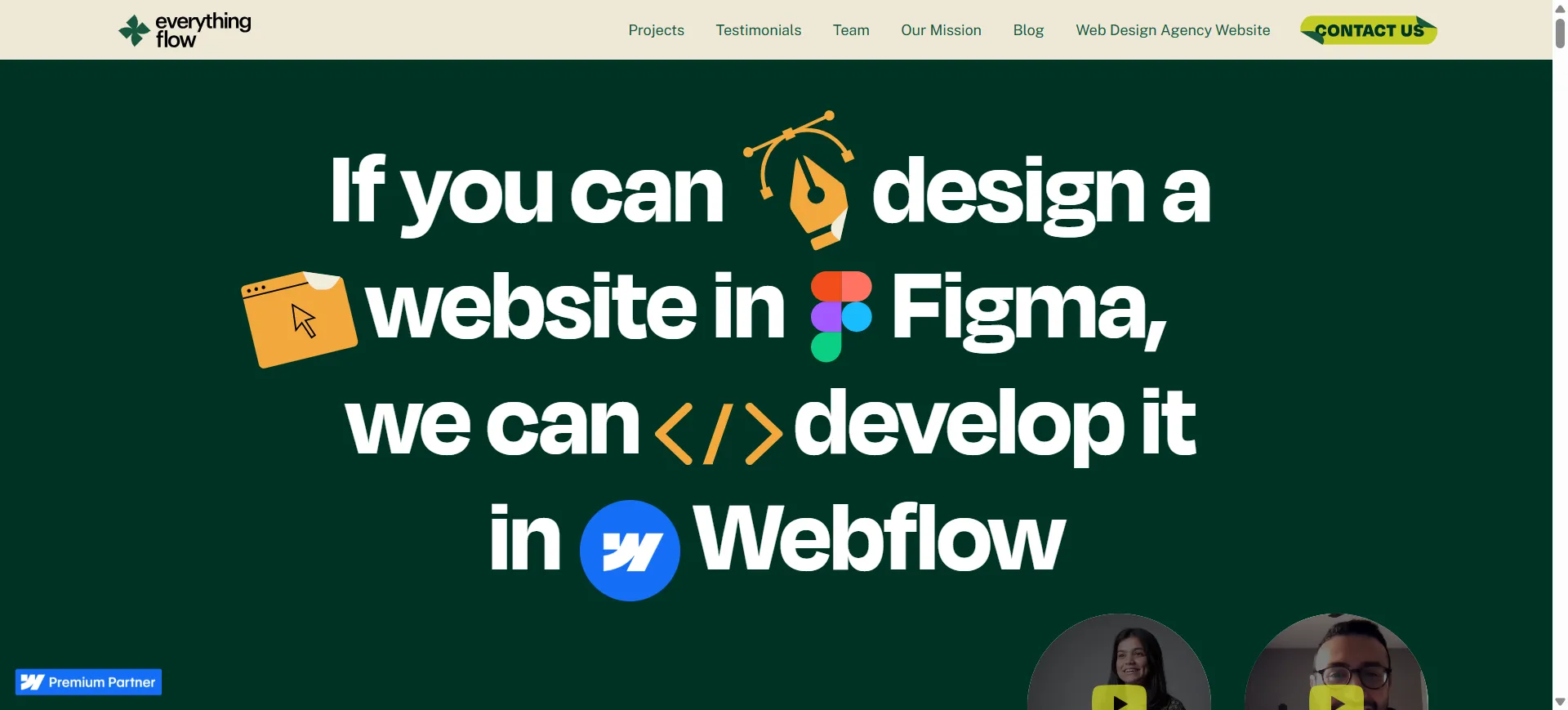
EverythingFlow is a creative and technically structured Webflow Premium Partner India agency that balances design innovation with backend organization.
The agency focuses on UX research, wireframing, UI systems, and component based Webflow development. They build reusable design elements to maintain scalability and consistency.
Everything Flow integrates marketing automation tools, analytics tracking systems, and lead capture frameworks into Webflow builds.
They provide Webflow website design, CMS configuration, integration services, redesign projects, and ongoing optimization support.
Everything Flow stands out for combining creative interface design with structured Webflow development processes that support long term website growth.
They work with startups, digital brands, SaaS companies, and growth driven organizations.
A Webflow Premium Partner India agency is a recognized Webflow expert company that demonstrates strong expertise in Webflow development, structured CMS implementation, performance optimization, and professional project execution.
Hiring a Webflow Premium Partner India ensures your website is built using best practices in design structure, responsiveness, scalability, and SEO optimization.
Evaluate their portfolio, experience in your industry, technical expertise, CMS structuring capabilities, and long term support services.
Yes. Many Webflow Premium Partner India agencies handle enterprise websites, SaaS platforms, and scalable digital ecosystems
Most agencies offer maintenance, performance monitoring, CMS updates, and scalability services post launch.
Selecting the right Webflow Premium Partner India agency is a strategic investment in your digital growth. A well structured Webflow website is more than a design project. It is a scalable business asset that supports marketing performance, lead generation, brand credibility, and long term expansion. Certified Webflow partners in India bring expertise in CMS architecture, responsive frameworks, performance optimization, and technical execution that ensures your website performs at its highest potential.
Whether you are a startup building your first scalable website, a SaaS company seeking conversion focused architecture, or an enterprise brand looking for structured digital transformation, partnering with an experienced Webflow Premium Partner India agency can significantly accelerate your growth journey. Each agency listed above offers unique strengths, allowing businesses to select a partner that aligns with their goals, industry, and technical requirements.
Sandeep Singh Sisodiya
February 4, 2026
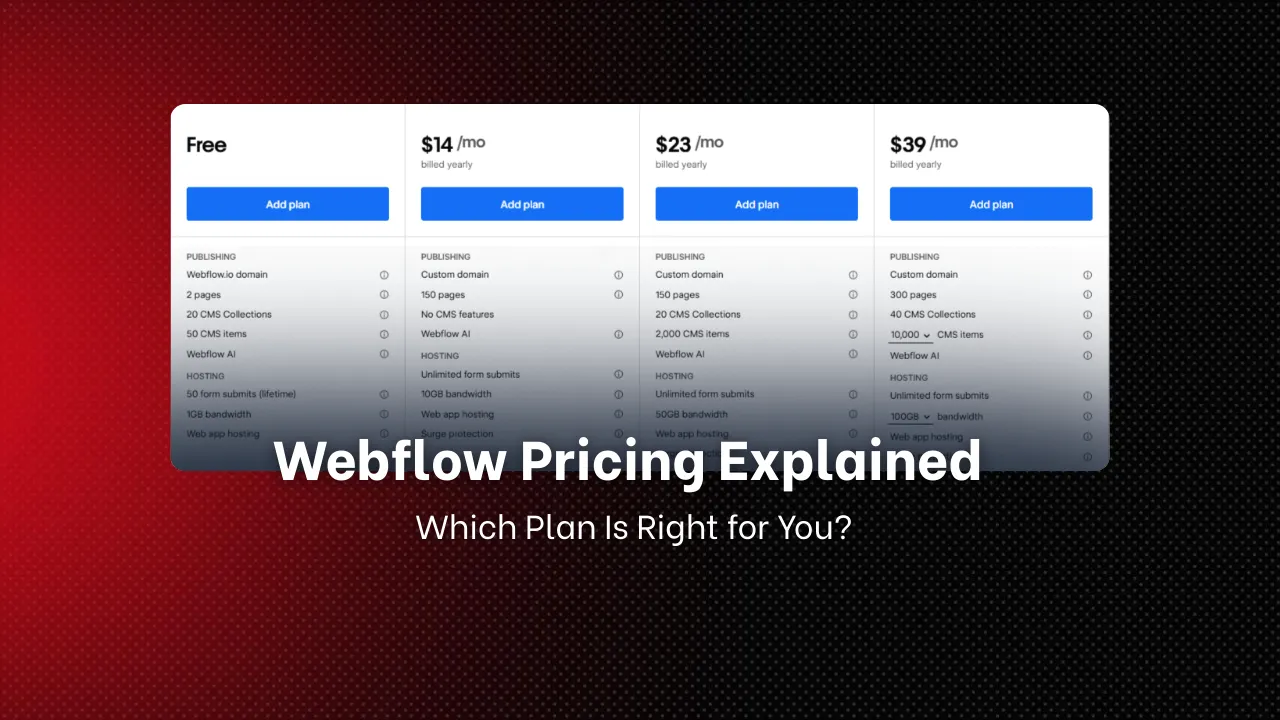
This guide explains each Webflow plan in detail, including Basic, CMS, Business, and Ecommerce options, along with workspace plans for freelancers and agencies. It highlights key features, limitations, and ideal use cases to help readers avoid overpaying or choosing a plan that restricts growth.
Webflow has become one of the most powerful website building platforms for businesses that want complete design freedom without sacrificing performance or scalability. Unlike traditional website builders, Webflow combines visual design tools, a robust content management system, and enterprise grade hosting in a single platform. This makes it especially attractive for startups, growing companies, and digital teams that want more control over their online presence.
Despite its popularity, Webflow pricing is often misunderstood. Many users struggle to choose the right plan because Webflow offers multiple pricing layers, each designed for different use cases. Selecting the wrong plan can result in unnecessary costs or limitations that impact future growth.
This blog explains Webflow pricing in detail. You will learn how Webflow plans work, what each plan includes, and which option is best for your business goals. By the end, you will have complete clarity on how to choose a plan that fits your needs today and supports your growth tomorrow.
Webflow pricing is divided into two main categories. Understanding this structure is essential before selecting a plan.
Site plans are applied to individual websites. These plans include hosting, bandwidth, CMS capacity, traffic handling, and ecommerce functionality. A site plan is required when you want to publish a website on a custom domain.
Workspace plans are designed for individuals, freelancers, teams, and agencies. These plans control how many projects you can create, how teams collaborate, and how websites are handed off to clients.
In many cases, businesses use a combination of both. For example, a company may use a workspace plan for collaboration and a site plan for publishing the final website.
Webflow site plans are ideal for businesses that want reliable hosting, strong performance, and flexible content management.
The Basic plan is designed for static websites that do not require dynamic content or a CMS.
- Custom domain hosting
- SSL security
- Fast global hosting
- Up to 150 static pages
- Limited form submissions
- Personal websites
- Simple business websites
- Landing pages
- Portfolio sites
- No CMS functionality
- Not suitable for blogs or frequently updated content
The Basic plan is best when content changes are minimal and dynamic features are not required.
The CMS plan is one of the most commonly used Webflow plans and is ideal for content driven websites.
- Dynamic content collections
- Up to 2000 CMS items
- Advanced SEO controls
- Higher traffic capacity
- Custom domain and hosting
- Blogs and resource centers
- Service based business websites
- Marketing focused websites
- Content heavy company sites
- No ecommerce functionality
- CMS item limit may restrict large publishers
This plan is ideal for businesses that rely on content marketing and SEO as growth channels.
The Business plan is designed for websites that experience high traffic or rapid growth.
- Up to 10000 CMS items
- High bandwidth limits
- Advanced performance optimization
- Priority support
- Enterprise level hosting
- High traffic websites
- Fast growing startups
- Large content platforms
- Media and publishing websites
The Business plan offers scalability and stability for companies that cannot afford downtime or performance issues.
Webflow ecommerce plans are built for businesses selling products online. These plans include storefront management, checkout features, and payment processing.
The Standard plan is designed for small ecommerce stores.
- Up to 500 products
- Custom checkout experience
- Integrated CMS product management
- No additional transaction fees from Webflow
This plan is suitable for small brands and startups entering ecommerce.
The Plus plan supports growing ecommerce businesses.
- Up to 1000 products
- Advanced shipping rules
- Abandoned cart recovery
- Higher monthly order limits
This plan works well for brands that are scaling their online sales.
The Advanced plan is built for large ecommerce operations.
- Up to 3000 products
- High order volumes
- Advanced integrations
- Enterprise level performance
This plan is best for established ecommerce businesses with consistent sales volume.
Workspace plans are ideal for professionals building and managing multiple websites.
This is a free plan designed for learning and experimentation.
- Beginners
- Students
- Testing Webflow features
The Core plan is suitable for freelancers and small teams.
- More project slots
- Basic collaboration tools
- Client ready workflows
The Growth plan is designed for professional teams.
- Unlimited projects
- Advanced collaboration
- Improved client management
The Agency plan is built for professional teams and agencies.
- Team permissions
- White labeling
- Client handoff tools
- Advanced billing options
Many businesses working with a Webflow development agency prefer this plan due to its scalability and client management capabilities.
A Basic or CMS site plan paired with a Starter or Core workspace plan is usually sufficient.
A CMS or Business site plan provides the flexibility needed for growth and content marketing.
Choose an ecommerce plan based on product count and expected sales volume.
A Growth or Agency workspace plan combined with appropriate site plans is the most scalable option. Many companies collaborate with a Webflow development agency to ensure the setup aligns with long term business goals.
- Start with the minimum required plan
- Upgrade only when limits are reached
- Choose annual billing to reduce costs
- Regularly review unused features
- Consult a Webflow development agency when planning large scale migrations
- Overpaying for unused CMS capacity
- Choosing a Business plan too early
- Ignoring ecommerce product limits
- Misunderstanding workspace versus site plans
Webflow may seem expensive compared to basic website builders, but it replaces multiple tools including hosting, CMS, security, and performance optimization. For businesses focused on scalability, design control, and long term value, Webflow delivers a strong return on investment.
Working with a Webflow development agency can further improve efficiency by reducing setup errors and ensuring the platform is used to its full potential.
Webflow pricing is flexible and powerful when understood correctly. The key to choosing the right plan is aligning your current needs with future growth rather than selecting the most expensive option upfront.
Whether you are building a simple website, managing a content platform, or scaling an ecommerce store, Webflow offers a plan that fits your goals. With careful planning and the right expertise, Webflow can serve as a long term foundation for your digital presence.
Search engine optimization is no longer a single discipline. What once revolved around rankings, backlinks, and keywords has now expanded into a much broader system of visibility, authority, and interpretation. For years, traditional SEO helped businesses grow predictably by aligning content with how search engines indexed and ranked information. Appearing on the first page was the goal, and traffic was the reward.
As we move through 2026, that model has fundamentally changed. Search engines are no longer passive platforms displaying results. They are intelligent decision systems that analyze intent, summarize information, and present answers instantly. Users increasingly rely on AI driven search experiences that eliminate the need to click through multiple pages. This shift has elevated Answer Engine Optimization from an emerging concept into a critical strategy. Understanding the difference between AEO and traditional SEO is now essential for any business that wants to remain visible, trusted, and competitive.
The way people search today reflects how technology has reshaped expectations. Users want clarity, not choices. They ask complete questions, expect context aware responses, and trust systems that provide immediate understanding. Whether through AI summaries, voice assistants, or conversational interfaces, modern search experiences aim to reduce friction.
This transformation has changed the definition of success. Visibility is no longer measured only by rankings. It is measured by whether a brand’s information is selected, summarized, and presented as an answer. Traditional SEO alone was not designed for this reality. AEO exists specifically to meet it.
Traditional SEO was built for an earlier version of search. Its goal was to help web pages rank higher by aligning with known ranking signals.
Traditional SEO focuses on relevance, authority, and accessibility. Keyword research identifies what users search for. Content is optimized around those terms. Metadata, internal linking, and headers guide search engines through a page. Technical optimization ensures fast loading, mobile compatibility, and proper indexing. Backlinks reinforce trust and credibility.
This system worked because search engines primarily acted as indexes. They matched queries to pages and ranked them based on quality signals.
Despite the rise of AI driven search, traditional SEO remains important. It provides the technical and structural foundation that allows content to be discovered. Long form resources, educational content, and transactional pages still rely on SEO to surface in search results. Without strong SEO fundamentals, even well written content struggles to gain visibility.
The limitation of traditional SEO lies in its original assumptions. It assumes users will browse results, compare links, and click through to websites. In reality, many users now receive answers directly within search interfaces. AI generated summaries often satisfy intent instantly. As a result, ranking does not always translate into influence or engagement.
Answer Engine Optimization is the practice of creating and structuring content so that AI systems can easily interpret, extract, and present it as a direct answer to user queries. AEO is not focused on ranking pages. It is focused on resolving intent.
Modern search platforms evaluate content differently. They look for clarity, accuracy, and contextual relevance. AEO ensures that information is structured in a way that machines can confidently reference.
To understand AEO, it helps to understand how answer engines think.
- They analyze questions rather than keywords
- They assess credibility across an entire topic
- They prioritize consistency and factual accuracy
- They extract meaning from structure and language
- They reward content that reduces ambiguity
AEO aligns content with these evaluation patterns, making it more likely to be selected as a trusted source.
AI driven search experiences are now embedded across platforms. Users encounter answers through search engines, browsers, mobile devices, and voice assistants. In many cases, decisions are influenced before a website visit ever occurs.
This means brands must earn visibility earlier in the journey. AEO determines whether a brand is included in AI generated explanations, comparisons, and recommendations. Being present in answers builds authority even without direct traffic.
Traditional SEO begins with keyword demand. AEO begins with user intent. Instead of asking what terms people search for, AEO asks what problem they are trying to solve and what outcome they expect.
SEO content often prioritizes coverage and length. AEO content prioritizes understanding. Clear definitions, logical flow, and contextual explanations matter more than keyword repetition.
Traditional SEO measures success through clicks. AEO measures success through presence and trust. Influence now happens before engagement, shaping perceptions early.
AEO does not replace SEO. It extends it. SEO ensures that content can be discovered and indexed. AEO ensures that content can be understood and referenced.
When combined, they form a complete visibility strategy. SEO builds the foundation. AEO builds interpretation and trust.
Content must now be written with clarity as the primary goal. Complex ideas should be explained simply. Assumptions should be minimized. Language should reflect how people naturally ask questions.
AI systems favor content that explains concepts step by step and avoids unnecessary abstraction.
Effective AEO content follows a logical structure. Questions are addressed directly. Answers appear early in each section. Supporting context follows naturally. This structure benefits both readers and machines.
Structured data helps search engines understand relationships within content. Schema markup provides context around articles, organizations, and frequently asked questions. While structured data alone does not guarantee visibility, it improves interpretability when paired with high quality content.
B2B buyers conduct extensive research before engaging with vendors. Much of this research now occurs through AI mediated discovery rather than traditional browsing.
Answer based visibility influences which brands are perceived as credible, knowledgeable, and trustworthy. This is where alignment with a strategic B2b branding agency becomes essential, ensuring consistent authority, messaging, and positioning across AI driven environments.
Traditional SEO metrics still matter, but they are no longer sufficient on their own.
Modern visibility measurement includes:
- Presence in AI generated answers
- Brand mentions within summaries
- Voice search references
- Assisted conversions influenced by early exposure
Success is increasingly measured by influence rather than immediate traffic.
AEO is particularly effective for businesses offering complex or expertise driven solutions. Technology companies, SaaS platforms, professional services, healthcare providers, and fintech brands benefit from being recognized as authoritative sources.
Organizations investing in advanced AEO services gain a competitive advantage by shaping how AI systems understand and present their expertise.
Many businesses misunderstand AEO and approach it incorrectly.
- Some treat it as a technical shortcut
- Others focus only on snippets
- Some ignore accuracy and freshness
- Others separate branding from authority
AEO is not a tactic. It is a long term strategy rooted in trust.
Search engines are evolving into decision engines. AI systems will increasingly compare options, evaluate credibility, and recommend solutions without requiring users to visit multiple sites.
Brands that succeed in this environment will focus on education, expertise, and consistency. They will optimize content ecosystems rather than isolated pages.
The difference between AEO and traditional SEO reflects a broader transformation in how digital visibility works. Traditional SEO remains essential for discoverability and technical accessibility. AEO defines how brands are interpreted, trusted, and recommended by AI driven systems. In 2026, success is no longer about ranking alone. It is about being answer ready.
Businesses that integrate strong SEO foundations with AEO focused strategies gain lasting relevance, authority, and influence. As search continues to evolve, those who adapt now will shape how they are perceived in the future.
In 2026, hosting is not just a technical checkbox because it affects SEO, paid campaign performance, lead capture reliability, and user experience. For teams that want to ship landing pages quickly without worrying about servers, Webflow positions its hosting as fast and reliable, with built-in CDN delivery and managed security.
At the same time, “managed hosting” comes with tradeoffs, especially if a project needs deep backend customization, custom caching rules, or server access. This review breaks down what Webflow hosting actually includes and how to evaluate it for speed, CDN behavior, and uptime expectations.
Webflow markets its hosting as “fast, reliable hosting” designed to work tightly with the Webflow Designer and publishing workflow, rather than acting like a separate hosting vendor. This matters because performance features like asset optimization, caching, and SSL are designed to be default behaviors, not optional add-ons you configure later.
Key included components to understand before analyzing performance:
Practical implication for marketers: the stack is designed to reduce maintenance overhead (no server patching workflow and no plugin-update cycle inside the hosting layer), which is useful when managing many client sites.
Webflow’s “speed” story is mainly built on two ideas: global edge delivery (CDN) and a managed platform that reduces the typical performance bottlenecks seen in plugin-heavy CMS setups. Because Webflow controls the hosting environment, it can standardize caching and delivery behavior, which tends to make performance more predictable across projects.
However, in real-world projects, Webflow site speed still depends heavily on build choices, not just hosting:
A practical way to evaluate Webflow hosting speed for your site type:
Webflow highlights CDN-backed hosting as a core feature, which typically means repeat visitors and static assets can be served from locations closer to the user, improving perceived speed. For marketing sites, the CDN is especially valuable because landing pages and asset-heavy pages often serve a large percentage of static content.
CDN benefits you can usually expect for Webflow-style sites:
Where CDN does not automatically solve everything:
Webflow positions its hosting as reliable, and its Enterprise offering is where formal guarantees are typically spelled out for organizations that need contractual uptime commitments. For many businesses, the key reliability advantage is that Webflow is a managed environment, so “site down due to plugin update” and “site down due to server patch” problems are reduced compared with self-managed stacks.
When uptime really matters (product launches, high-budget ad pushes, webinar registrations), consider these operational best practices:
Even with strong managed hosting, the highest ROI comes from making the site “easy to deliver”:
Conclusion: Webflow hosting in 2026 is a solid choice for most marketing websites, content-led B2B sites, and landing-page programs because it bundles CDN delivery, managed SSL, and a reliability-focused hosting experience into one platform. It is especially compelling for teams that want predictable publishing and fewer hosting moving parts, while Enterprise becomes relevant when you need formal uptime terms and enterprise-grade procurement assurances. If your project requires deep server control or specialized backend behavior, Webflow can still be used for the front end, but hosting architecture may need a different approach depending on those requirements.
Most teams evaluate a Webflow template the same way they evaluate office furniture: "Does it look good, and can we start using it today?" That is a fair starting point for a Minimum Viable Product, but it is not how high-performing marketing sites are actually won or lost in 2025. The real difference between a template site and a custom Webflow build isn't aesthetics; it is how quickly the business can adapt, test, and compound improvements without turning every change into a mini development project. When you rely on a template, you often inherit a rigid structure that forces your content to fit the design, rather than a design that amplifies your content strategy.
Custom Webflow development often "pays back" in places that don't show up in a basic quote: campaign velocity, reduced dependency on developers for routine updates, fewer rebuild cycles, cleaner governance as the site scales, and a tighter connection between brand, UX, SEO, and conversion. In other words, the ROI isn't hidden because it is mysterious - it is hidden because most teams measure the wrong things, focusing solely on the initial build cost rather than the Total Cost of Ownership (TCO) over 18 to 24 months. A custom build transforms your website from a static brochure into a dynamic growth engine, capable of evolving at the speed of your market.
ROI for a website isn't just "cost to build vs. revenue." It is the sum of all the advantages the site creates (and the friction it removes) across marketing, sales, product, recruiting, partnerships, and customer success. A practical way to think about it is this: templates optimize for starting fast, while custom development optimizes for staying fast. Starting fast matters, but staying fast is what compounds - especially when your site is a living system that needs weekly changes.
Here is what often gets missed in template-first decisions that creates a "debt" you pay later:
Custom Webflow development isn't automatically "better" just because it costs more. The ROI shows up when customization is used to remove friction and build a scalable system - not just to add visual flair.
Some teams care less about "how it's built" and more about "how fast it can change," and that shift is at the center of modern web ROI thinking. When your marketing team can publish new pages quickly, you don't just save time - you create more attempts, more learning, and more chances to win. This is often referred to as "campaign velocity."
Recent 2025 data highlights this gap vividly. Marketing teams using custom Webflow builds report being able to make site changes in as little as 20 minutes - tasks that previously required expensive developers 4 to 5 hours to complete on traditional platforms. This isn't just convenience; it is a direct operational saving that compounds every week. If your team launches two campaigns a month, saving 10 hours of developer time per campaign adds up to over 240 engineering hours saved annually.
A custom build gives you a "system vs. one-off" advantage:
One of the most significant but overlooked areas of ROI in custom Webflow development is the elimination of maintenance overhead. Traditional platforms like WordPress often carry a "plugin tax" - the ongoing cost of updating, securing, and debugging a patchwork of third-party tools.
In 2025, the cost difference is stark. A typical corporate WordPress site requires approximately 4 to 8 hours of monthly maintenance for plugin updates, security monitoring, and backup management. Financially, this often translates to reactive security retainers costing $600 to $1,200 annually just to keep the site safe. In contrast, Webflow's managed hosting environment handles core platform updates, SSL, and security patches automatically, bringing active maintenance time down to near zero.
This "no-maintenance" dividend means:
Performance is a conversion feature. When pages load fast globally, your paid traffic performs better, your SEO ceiling rises, and your sales team can confidently send prospects to pages that won't stall. Custom development allows for "performance by design" rather than "performance by accident."
A compelling 2025 micro-case study of a B2B SaaS firm illustrates this impact. By optimizing their custom Webflow build, they cut homepage load times from 3.7 seconds to 1.6 seconds. This speed increase wasn't just a technical vanity metric; it drove a 21% increase in trial signups and a 9% jump in Monthly Recurring Revenue (MRR) within two quarters.
Template sites often suffer from "code bloat" - loading scripts and styles for features you don't even use. A custom build ensures you only load what you need. Webflow's infrastructure supports this with global CDN delivery (now powered by Cloudflare's latest network as of April 2025) and automatic image optimization. However, the custom implementation ensures the structure itself is lean.
Key performance ROI drivers in custom builds include:
Security is usually treated as an IT checkbox, but for mid-market and enterprise companies, it is a revenue protector. A hacked site means lost trust, lost leads, and expensive remediation. Templates often lack the strict structural governance required by enterprise security teams.
Webflow's enterprise-grade security features - including SOC 2 Type II compliance, ISO 27001 certification, and Single Sign-On (SSO) - provide a robust foundation. A custom build leverages these features to create a secure, governed publishing workflow.
For example, custom governance roles allow you to define exactly who can publish to the live site versus who can only draft content. This reduces the risk of accidental "site breaking" changes - a common issue when junior team members are given full admin access to a template theme.
Templates often assume a simple funnel: visitor - contact form - email. Real revenue funnels are messier and more complex. They involve attribution, data enrichment, CRM workflows, lead routing, scheduling, chat, personalization, retargeting, and post-signup education.
Custom Webflow development adds ROI by designing pages around your actual funnel mechanics, not a generic placeholder.
This integration-first approach shortens the path from "traffic" to "action," effectively plugging leaks in your marketing funnel.
To make the "hidden ROI" visible to stakeholders, you need to measure outcomes that templates rarely optimize for. Use this simple framework to tie custom development directly to business impact.
Ask: what is the site supposed to do in the next 12 months?
If the job is "look modern," a template might be enough. If the job is "enable growth loops," you need system-level flexibility.
Examples: Increase demo requests from a specific segment, build an SEO moat, or support a massive hiring push.
Avoid vanity metrics. Pick a mix that reflects business health:
This is where custom development becomes a business strategy.
It is important to be honest: custom development isn't always the right answer. Templates are the correct choice in specific scenarios where speed-to-live is the only metric that matters.
Templates make sense when:
Even in these cases, a "minimum custom layer" - updating typography, colors, and key imagery - can bridge the gap. But for a primary marketing engine, a template is often a short-term loan with high long-term interest.
Template sites often feel like the "practical" decision because they minimize upfront cost and get something live quickly. But growth teams don't win because they shipped a site; they win because they shipped improvements, shipped experiments, shipped new offers, and shipped clearer positioning faster than their competitors. Custom Webflow development pays for itself when it turns your website from a static brochure into an agile engine for that kind of shipping.
The hidden ROI becomes obvious once the site is treated as a scalable product: modular components, a CMS that supports expansion, governance that keeps quality high, and performance that protects every visit. By trading the chaos of plugin maintenance and rigid themes for the agility of a custom system, you stop paying "rent" on your tech stack and start building an asset that compounds in value. The real goal isn't just to build something custom - it is to build something that keeps paying you back every single week after launch.
He is the CEO of Appsrow and a Webflow leader based in Ahmedabad, India.
He leads strategy, growth, and overall business direction.
Yes, he actively contributes to the Webflow ecosystem in India.
SaaS, AI, and enterprise businesses.
Growth strategy, digital transformation, and conversion optimization.
By aligning website strategy with business goals and improving conversions.
Turn your website into a growth engine with expert strategy and execution.
.webp)
.webp)